

Web is more than business. Why uniqueness online will soon be a scarce commodity.
In a few years, we'll miss websites with a soul.
Sounds dramatic? Maybe. But just spend an hour browsing the web and you'll feel what I mean. You could swap the logo and no one would notice the difference.
And I don't say this out of spite. I say it as a diagnosis of a trend that's just picking up speed.
WordPress was just a warm-up
When WordPress democratized website creation, the world was flooded with identical themes from ThemeForest. Everyone recognized the "WordPress look" — that characteristic design you could spot from a mile away.
But at least back then it was a matter of budget. Someone who wanted to and knew how could do something different.
Today we're entering an era of even deeper uniformity. AI generates layouts in seconds. Page builders promise a "professional look" with zero effort. Framer, Webflow, dozens of no-code tools — each with its own characteristic fingerprint that you start recognizing instantly after a while. And language models trained on billions of existing pages will, by definition, generate a regression to the mean.
The result? A web full of pages that work, maybe convert, are accessible — but say absolutely nothing about the person or brand behind them.
We see the same phenomenon beyond the web. In architecture — glass-box office buildings that look identical in Warsaw, Dubai, and Shanghai. In music — productions optimized for streaming algorithms, with identical tempo and structure. In fashion — logo on logo, because branding replaced style. Optimization has displaced character.
Business websites have their own rules. And that's fine.
Before I go further — an important disclaimer.
I'm not saying every website should be an artistic experiment. Business websites have their own rules and their own goals. Clear messaging, intuitive user flow, conversion, WCAG compliance, GDPR, Core Web Vitals — all of this matters and can't be neglected. I do this myself and I do it well.
The problem is that "good enough" is becoming the only available standard. That even where you don't need to be transactional, where you can say something, show a perspective, leave an impression — people choose the safe template. Because it's faster. Because it's cheaper. Because it "works."
But the web isn't just a place for business. It's a medium. And like any medium — it can be a tool or it can be art.
How I built the "Lumière" demo
Can a website be an environment rather than a document?
Not a landing page. Not a portfolio with a grid layout. Something you're actually inside for a moment. Something that leaves an image in your head after you close the tab.
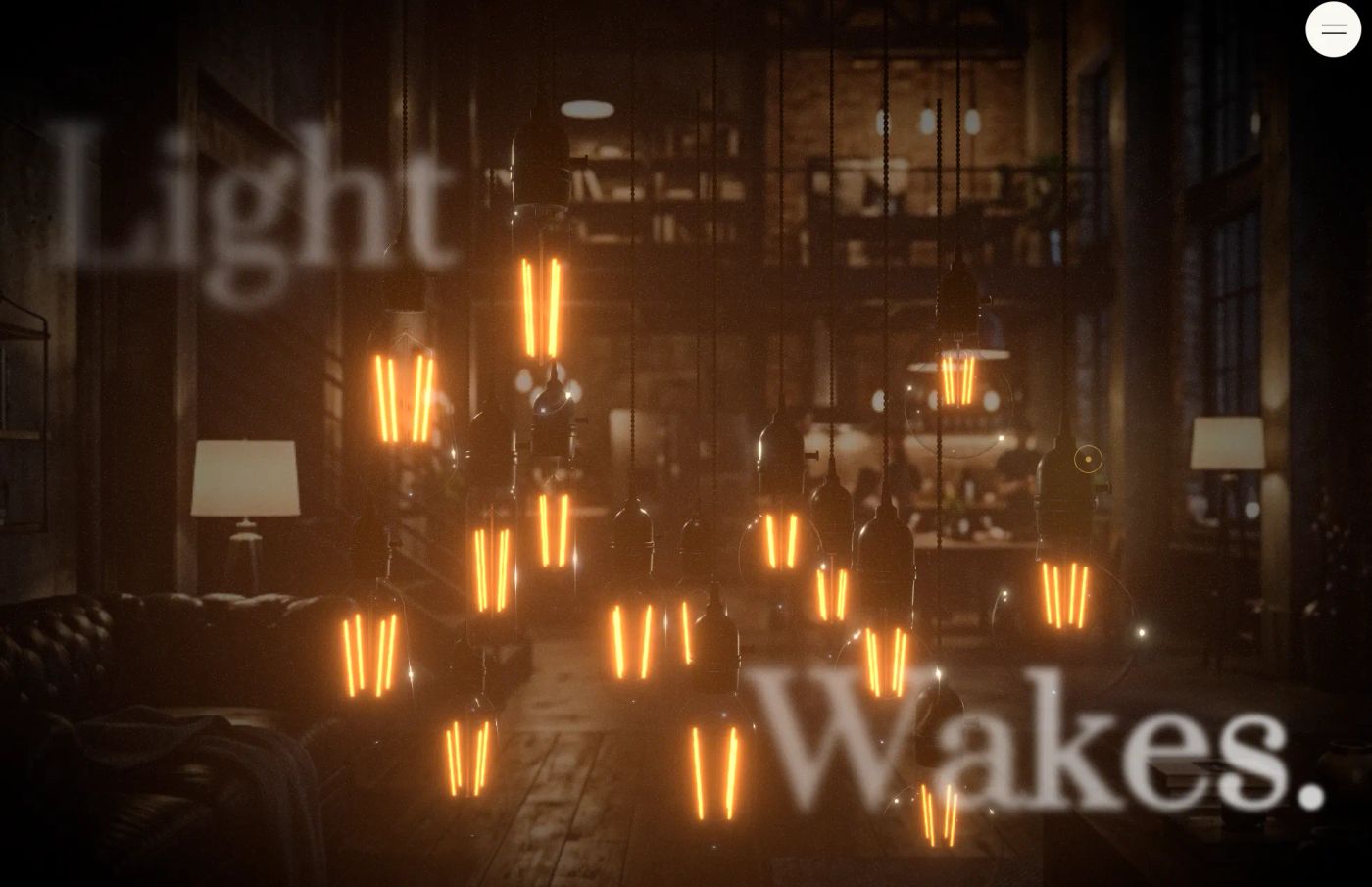
The page opens in darkness. A photorealistic 3D model of a lamp — rendered via WebGL and React Three Fiber — hangs in three-dimensional space. As you scroll, it slowly lights up, flooding the screen with warm, amber light until the entire background turns white.
This isn't an effect for effect's sake. It's a narrative decision. The moment of arriving on the page matters just as much as everything that follows. The first seconds aren't "loading time" — they're the first sentence of the story.
Underneath — an entire technical layer that makes this narrative possible:
GSAP ScrollTrigger synchronizes the choreography of animations between sections with frame-perfect precision. Text breaks down into individual letters and animates in cascade. Photos emerge from darkness as the cursor moves.
A native canvas element draws a luminous trail in real time — using Bézier curves and radial gradients — as the user explores the Works section.
The LightStudy section creates the illusion of a moving spotlight: a circular mask follows the cursor, revealing a bright version of an interior hidden beneath a dark surface.
The navigation reads the background it floats above and dynamically changes color — white on dark, dark on light. A detail most visitors will never consciously notice, but would immediately feel its absence.
Typography: Cormorant Garamond italic. The contrast between the delicate strokes of serif letters and the cinematic darkness of the background is not accidental. Every layer of the design has intention.
Technical requirements and compliance — something a cheap contractor won't deliver
There's one more layer to this conversation that rarely gets mentioned when talking about "creative" websites.
Unique design and advanced interactions don't exempt you from responsibility. The site must be accessible — WCAG compliant. It must respect GDPR and cookie regulations. It must load fast so Google doesn't penalize it. It must work on mobile devices.
The average cheap contractor — whether a person generating pages in AI with little understanding of what matters, or an agency cobbling together a template in Elementor — simply doesn't cover these aspects. Not because they don't want to. Because they don't know it's important, or because the margin doesn't allow for it.
Meanwhile, this is precisely the standard you should start from — not a goal you chase after the fact.
The hunger for uniqueness is already coming
History has a certain rhythm. After every wave of uniformity, a backlash follows. When pop music became too polished, indie and lo-fi emerged. When fast fashion dominated the streets, thrift stores and slow fashion came back. When modernist architecture flooded cities with concrete rectangles, interest in historic tenements and local craftsmanship was revived.
On the web, the signals are already there. The anti-design movement, a renewed interest in skeuomorphism, experiments with brutalist web design, Awwwards galleries full of projects that treat the browser like a stage. More and more people are actively looking for websites that feel like something — not just work.
In the coming years, creativity and uniqueness will be among the most important differentiators on the web. Breaking through a sea of soulless, generated pages will require more than a good template. Design and code can be a form of expression — not just a sales tool.
In a world where everything looks the same, style becomes strategy.
What this means
Lumière is a project I wanted to do for myself — to see what's possible when there are no compromises toward "good enough." To show that the browser is a fully legitimate artistic medium, not just a display for forms and price tables.
But this is also my standard on every project. Understand the person. Define the feeling. Build with precision. No templates. No shortcuts. No details left to chance.
If you're building something you want to be remembered — find out more about how Next.js websites are built.
🔗 Live demo: lumier-demo.vercel.app